
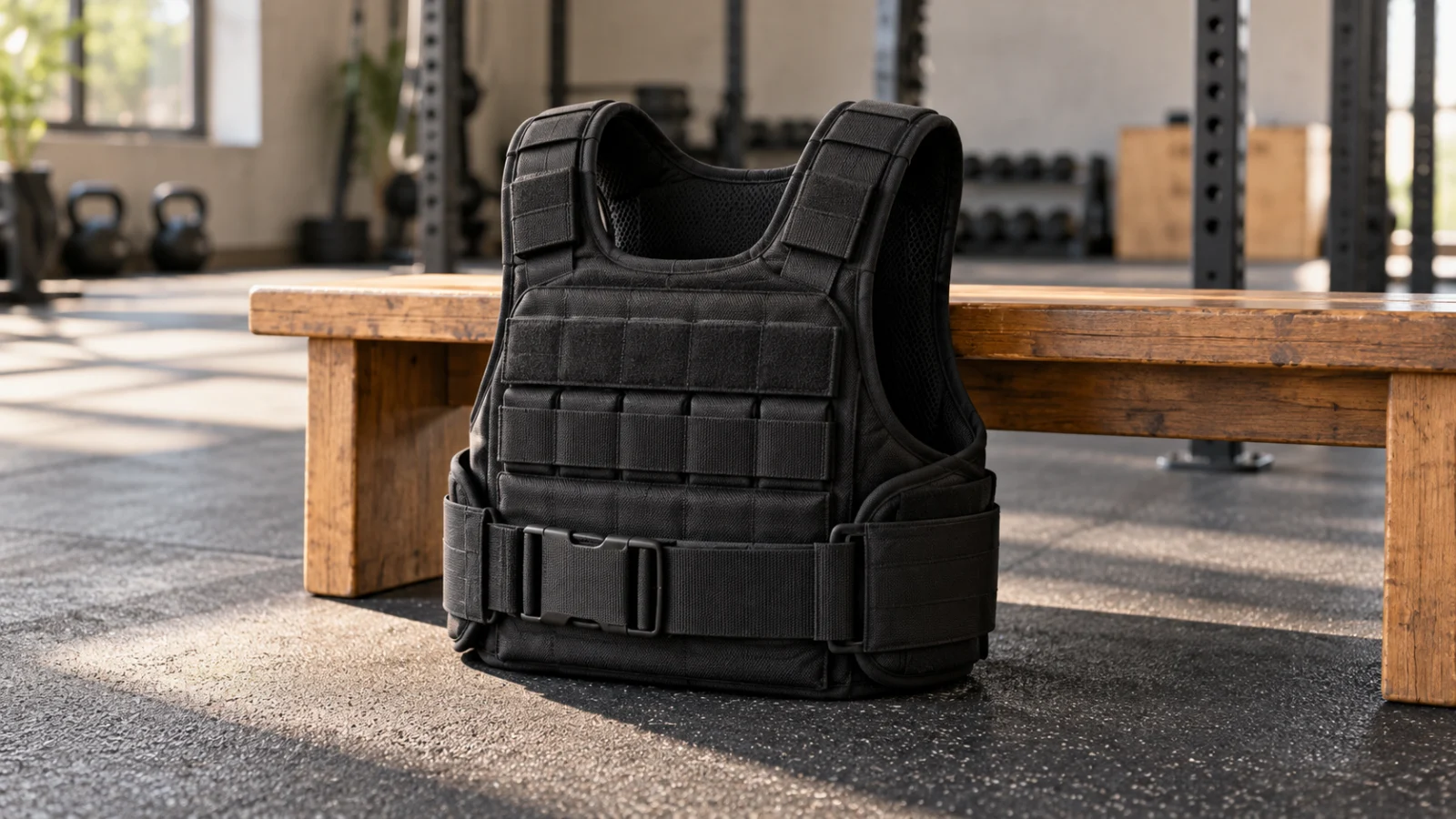
Which weighted vest should you choose for CrossFit?
A useful vest stays stable during your planned movements, lets you adjust the load and fits your body. Maximum capacity is not enough to choose: a vest advertised at 15 kg is not automatically more appropriate than a 10 kg model.
This guide compares two Sveltus references in the Amazon catalogue: the 10 kg vest and the 15 kg Pro. This is a document-based comparison, not a Wodball hands-on test. Available prices update in the blocks below; confirm the exact package before ordering.
Compare the two references
Cet article contient des liens d’affiliation. Si vous effectuez un achat via ces liens, nous pouvons percevoir une commission, sans frais supplémentaires pour vous. En tant que Partenaire Amazon, je réalise un bénéfice sur les achats remplissant les conditions requises.
| Product | Where to buy |
|---|---|
 | |
 |
The variants and EANs are linked to the product records. Separately sold plates should not be confused with a complete vest, even when pictures or product names look similar.
Sveltus 10 kg: a compact option to compare
The selected reference is the black Sveltus vest advertised at 10 kg, EAN 3412181017963. That describes the product; it is not a recommended starting load.
Before buying, check size adjustment, how weight can be changed and the minimum usable load. Examine fastener positions too: they should not interfere with your intended movements.
Sveltus 15 kg Pro: a steel-plate system
The Pro 1799 reference uses steel plates and shoulder and torso adjustments. Sveltus lists two 2.5 kg plates and two 4 kg plates supplied, for a vest presented with a maximum capacity of 15 kg. Its EAN is 3412181017994.
Check that the offer includes the vest and stated plates. For a workout requiring a precise load, verify the actual total worn and possible combinations. Adding plate weights without accounting for the vest can produce a different total.
What matters before the price?
Fit and freedom of movement
The vest should adjust without excessive movement or restricting the task. Examine tightening systems, dimensions and seams. Running, push-ups and pull-ups place different demands on the vest.
Minimum load and adjustment increments
Compare empty vest mass, included weights and available increments. High capacity does not necessarily mean fine adjustment. Check how weights are secured in their compartments.
Care and replacements
Read cleaning instructions and check compatible spare parts. Plates from another brand may have different dimensions, shape or fixings.
The complete cost
Include delivery and the weights you need. A cheaper listing may cover an empty vest, accessory or different package. Photos alone do not establish what is supplied.
For Murph: check the prescription first
The official Murph page mentions a 14 or 20 lb vest, approximately 6.35 or 9.07 kg. Those are not identical to 10 or 15 kg. A vest’s commercial name does not guarantee that it adjusts to the intended load.
Murph already involves substantial running and bodyweight volume. A vest is not an automatic addition to a first attempt. Choose adaptations with your coach and record the load and actual version.
Other workouts where the vest matters
Riley
Riley combines two 1.5-mile runs with 150 burpees. Its official prescription mentions a vest if available without specifying a load. Running fit and ground transitions deserve attention alongside maximum capacity.
Stairway to Heaven
This Garage Gym Athlete benchmark uses two weighted EMOM blocks followed by unweighted work. The WODwell version lists 40/30 lb, then 20/14 lb. Forty pounds exceeds 18 kg, so neither vest here covers that load. Check the other increments rather than equating a 15 kg model with the entire prescription.
Sisson
Sisson is a 20-minute AMRAP of a 15-foot rope climb, five burpees and a 200 m run. CrossFit mentions a 20 lb vest if available. Consider rope-climbing demands and vest stability with your coach.
These are usage examples, not a programme to complete consecutively or a reason to begin at the prescribed load.
Use the vest for a defined purpose
Choose exercise, load and volume before putting it on. Check fasteners and weight distribution, then observe stability during movement. The aim is not to make every session heavier.
Unweighted proficiency does not guarantee the same volume is suitable with a vest. Account for experience and manufacturer guidance. Stop and reassess the setup if it interferes with breathing or movement.
Frequently asked questions
Is a 10 kg vest suitable for a beginner?
Capacity alone cannot answer. Minimum usable load, exercises and experience matter. Unweighted training remains a valid option.
Can a 15 kg vest provide roughly 9 kg?
Only if its loading system permits the desired total, including the vest itself. Check increments before buying and weigh the assembled setup.
Which model is best?
That depends on fit, load adjustment and budget. Without comparative testing, we do not assign comfort or durability scores.
Sources and method
- Sveltus — 15 kg Pro vest
- CrossFit — Murph
- Amazon.fr catalogue via NordicWeb: variants, EANs, images and offers. Document-based comparison without hands-on testing.
 Rameur à la maison : place, bruit et budget à prévoir
 Haltères réglables ou fixes : lesquels choisir à la maison ?
 Quel rameur choisir pour le CrossFit et le HYROX à la maison ?