
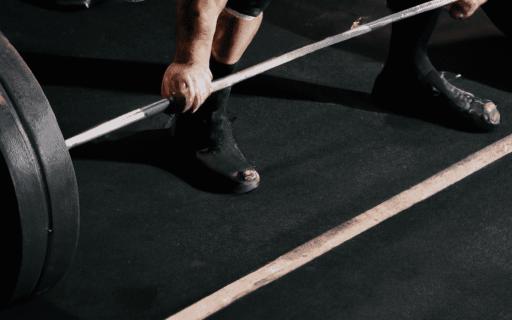
1. The starting position
A conventional deadlift usually begins with the bar at a defined floor height. Establish the setup before pulling to standing. Plate size or raised supports can change that starting task.
A Romanian deadlift normally begins standing with the load in the hands, followed by a controlled lowering. Getting the load into that starting position still needs an appropriate setup.
2. The lower limit
In a floor-start conventional deadlift, the intended start height defines the bottom of the repetition. Confirm whether subsequent repetitions reset or use another specified convention.
In an RDL, the lower limit follows the controlled range of the hinge rather than a compulsory floor touch. There is no universal shin height that every athlete must reach.
3. Hip, knee and trunk movement
The conventional setup uses the hip and knee bend required to reach its start while remaining organised for the pull. An RDL generally uses a more modest knee bend while the torso inclines through the hinge.
A controlled back position is different from a torso that stays vertical. The torso changes angle during an RDL; describing it as completely upright would obscure the hinge. Exact positions also vary with proportions and setup.
4. The emphasis of the task
Both involve the hips, legs and trunk, with grip and upper-body support contributing to holding the load. The difference is not that one trains the whole body while the other leaves the upper body uninvolved.
The RDL is often used for controlled hinge and posterior-chain work. A conventional deadlift practises the pull from its defined start. Select according to the programme rather than assigning a universal winner.
5. How you programme and compare them
Choose load, repetitions, tempo and recovery for the specific variation. A load used in one lift is not automatically suitable for the other. Technical practice, strength sets and conditioning also need different decisions.
Record starting height or lower limit, load, repetitions and reset convention. Two results labelled deadlift are not necessarily the same task.
Dumbbells and other variations
Either pattern can be practised with suitable equipment, but independent dumbbells change the grip, placement and start height. Read the dumbbell deadlift guide before treating a change of implement as an exact substitution.
Begin with a version that lets you observe the movement. If a position repeatedly changes, review range, load and set length with your coach.
Frequently asked questions
Must the RDL touch the floor? No. Its working range is not defined by a compulsory floor contact.
Is the RDL a squat? It is organised as a hinge; adding substantial knee bend can change the intended task.
Should I choose one forever? No. A programme may include both for different purposes, with workload and recovery planned accordingly.
Sources and related guides
Catalyst Athletics: Romanian deadlift · CrossFit: the deadlift · Wodball deadlift guide
 Le soulevé de terre avec haltères
 Maîtriser le soulevé de terre roumain en CrossFit®