
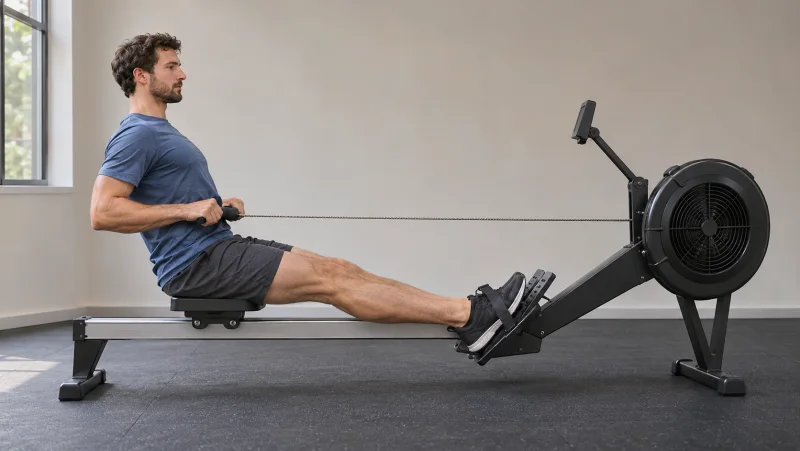
What does a 500 m split mean?
A pace of 2:00/500 m means that 500 m would take two minutes at that speed. A smaller number is a faster displayed pace: 1:55/500 m is faster than 2:05/500 m. Pace is not stroke rate, which counts strokes per minute.
The calculator connects three values: distance, average pace and time. Choose the value to calculate and enter the other two. It runs in your browser without an account and does not send your entries to an external service.
Rowing-pace calculator
How do the three modes work?
Calculate time over a distance
Enter distance and 500 m pace. For example, 2,000 m at 2:00/500 m gives eight minutes. The calculation assumes that average pace is held for the whole distance; it does not include recovery or station changes.
Calculate average pace
Enter the completed distance and time spent rowing. A 1,000 m piece in 4:30 gives an average of 2:15/500 m. That describes the piece without deciding whether the effort suits your session.
Calculate distance
Enter duration and average pace. Ten minutes at 2:00/500 m mathematically gives 2,500 m. For intervals, use work time only if you want distance rowed at that pace: rest periods are not time spent moving at the same speed.
Reference table: 500 m to 5,000 m
These correspondences assume a constant pace. They are not ability targets. A 500 m performance does not demonstrate that you can hold the same pace over 5,000 m.
| Pace /500 m | 500 m | 1,000 m | 2,000 m | 5,000 m |
|---|---|---|---|---|
| 1:45 | 1:45 | 3:30 | 7:00 | 17:30 |
| 2:00 | 2:00 | 4:00 | 8:00 | 20:00 |
| 2:15 | 2:15 | 4:30 | 9:00 | 22:30 |
| 2:30 | 2:30 | 5:00 | 10:00 | 25:00 |
| 3:00 | 3:00 | 6:00 | 12:00 | 30:00 |
The formulas explained
Convert time to seconds first. For distance D in metres, time T in seconds and pace P in seconds per 500 m:
- Time: T = P × D ÷ 500.
- Pace: P = T × 500 ÷ D.
- Distance: D = T × 500 ÷ P.
A pace of 2:15 equals 135 seconds, not 2.15 minutes. The inputs deliberately separate minutes and seconds to avoid that mistake. Duration results are rounded to a tenth of a second; a tiny difference from a whole-second display can come from rounding.
Using the numbers in a WOD or HYROX
In a mixed workout, arithmetic does not choose your pace. The overall time also includes what happens before and after rowing. An average held on a fresh standalone test is not a promised result after running or another exercise.
Explore the rowing WOD and CrossFit workout selection for different workout contexts. Our rowing-technique guide explains how to interpret the measurements.
Pace, stroke rate, watts and calories are different
Two people at the same stroke rate can display different paces. Stroke rate counts cycles; pace describes time over distance. Watts and monitor calories are other indicators. This calculator does not convert WOD calories into metres or estimate your body’s calorie expenditure.
The PM5, damper and drag-factor guide helps you find the relevant displays. On another brand, check how its manufacturer defines the measurements before comparing results.
Frequently asked questions
Why does the calculated time differ from my session time?
Check that you used average pace, the correct distance and time excluding any pauses or transitions. The instantaneous number changes from stroke to stroke.
Can one 500 m effort predict a 2,000 m time?
The calculation gives the time corresponding to a maintained pace. It does not predict whether you can sustain that pace over a longer distance.
Should I choose a faster pace every week?
This is not a training programme. It helps interpret a result or prepare a monitor setting; it does not prescribe an individual progression.
Sources
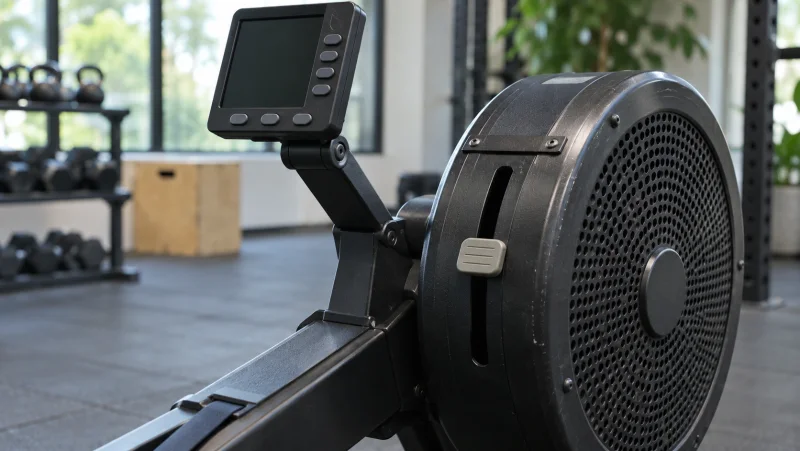 Réglage du rameur Concept2 : damper, drag factor et écran PM5
 WOD rameur : séances CrossFit