
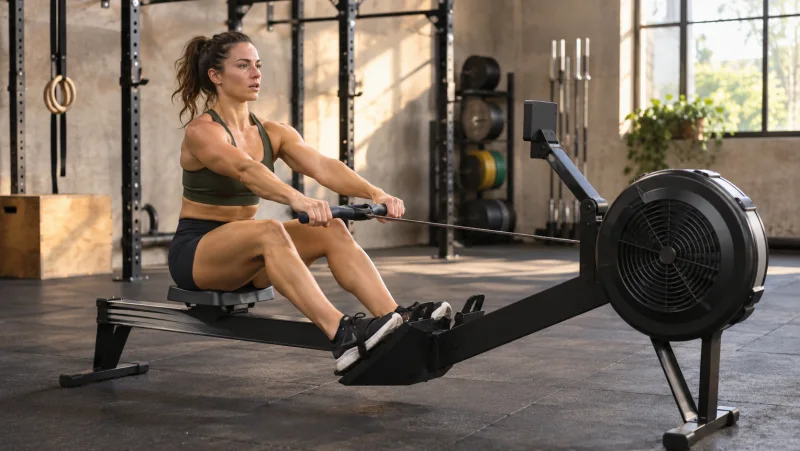
Which rowing WOD should you choose?
A rowing WOD does not necessarily mean spending the entire session on a rower. Rowing may open a sequence, return each round or appear as a timed station. Look at the surrounding work: running after 2,000 m creates a different task from moving to thrusters and pull-ups after 1,000 m.
This selection uses three workouts already published in Wodball’s library. The live blocks below load their workout records. Read the full programme and choose an appropriate version before starting; reference prescriptions are not compulsory starting points for beginners.
| Workout | Where rowing fits | What affects your approach |
|---|---|---|
| Jackie | A distance before thrusters and pull-ups | Leaving capacity for the barbell and grip |
| Jerry | A rowing piece between two runs | Being able to return to running |
| Fight Gone Bad | A one-minute calorie station | Station changes and the overall score |
Jackie: row before the barbell and pull-ups
Jackie opens with a 1,000 m row, followed by 50 thrusters and 30 pull-ups. The clock covers the entire sequence. Treating the opening row as a standalone test can make the remaining work harder to manage.

Choose a suitable thruster and pull-up version before starting. Plan the station changes and any sets you expect to break. Record the overall time alongside the changes you made: that context matters when comparing another attempt.
Jerry: run, row, run
Jerry combines a one-mile run, a 2,000 m row and another one-mile run. The row sits in the middle, with running still to come. A mile is approximately 1.6 km; check the route you use for repeat comparisons.
Prepare a running route and rower access that avoid unnecessary uncertainty. Observe the transition into the final run: any time gained on the machine belongs in the context of the whole workout. If you shorten the distances, record them rather than presenting the result as the original prescription.
Fight Gone Bad: a one-minute rowing station
Here, rowing for monitor calories forms one station in a circuit. Move when the clock calls for the next station; the clock does not stop between movements. The prescribed rest separates rounds. The workout record gives the three-round version.
Rowing calories contribute to the score while other stations count repetitions. This is a workout scoring rule, not a general conversion between calories, metres and reps. Prepare machine settings beforehand and account for the time needed to change stations.
How can you adapt the workout?
- Start with movement choices: agree appropriate variations with your coach, particularly for pull-ups and barbell movements.
- Adjust volume where needed: reducing distance or reps changes the workout, so record what you actually completed.
- Agree any time cap: also define what to record if work remains when time ends.
- Keep settings consistent: repeat comparisons are more useful with similar machines, units and conditions.
If the stroke is new to you, start with our rowing-technique guide. The Concept2 settings and PM5 guide explains the monitor and machine setup.
What pace should you hold during a rowing WOD?
No single pace suits all three sessions. Consider distance, experience and the movements still to come. Record average pace rather than relying on an instantaneous number from one stroke.
Our rowing-pace calculator converts a 500 m split into a time over a distance. It explains the numbers; it does not choose your intensity or predict your WOD result.
Frequently asked questions
Can you do a WOD with only a rower?
A session can be built around rowing alone, but these three workouts include other movements. Read the full workout before preparing; continuous rowing is not automatically an equivalent replacement for the sequences shown here.
Can you replace metres with calories?
There is no universal conversion. These units represent different measurements. Clarify the purpose of the adaptation rather than applying a ratio without its context.
Should every rowing piece be all-out?
The score covers the whole session. An acceleration that prevents you from moving into the next exercise may change the value of that choice. Review the overall result and how the transitions went.
Sources
 Hotel WODs: three short workouts for travelling
 No-equipment WODs: Cooper, Bert and a Riley variation
 Beginner WODs: five workouts and ways to scale them