
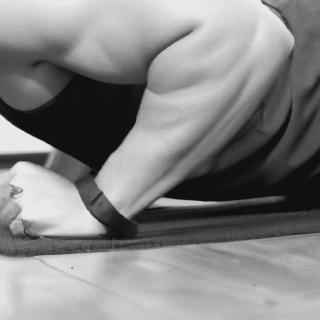
What is a wall walk?
A wall walk takes you from the floor towards a wall-facing handstand and back down. Your feet move up the wall while your hands move towards it, then you reverse the sequence. The return to the floor is part of the repetition, not an optional finish.
It can introduce supported inversion and challenge shoulder endurance and trunk control. It is not automatically an easy warm-up, especially when repetitions accumulate. See our handstand guide for the wider progression.
Set up and learn the ascent
Use a clear wall suitable for exercise and a non-slip floor. Leave enough space around you and learn how to return to the ground with a coach before attempting a near-vertical position. Begin from a range you can reverse confidently.
From the starting floor position, press up and establish support through the hands. Walk the feet up the wall while moving the hands back towards it in controlled steps. Keep the trunk organised rather than letting the lower back sag. The goal is a stable position you can leave deliberately, not getting your face as close to the wall as possible.
Watch the CrossFit wall-walk demonstration to recognise the movement. Individual coaching helps choose an appropriate starting range and progression.
Practise the descent
Walk your hands away from the wall as your feet descend. Continue controlling the load through your arms and trunk until you can return to the floor. Do not slide down abruptly or collapse when you become tired.
Keep enough capacity in reserve to complete this return. If you cannot reverse the ascent smoothly, shorten the range or reduce the repetitions before the next attempt.
Common mistakes
- Losing trunk position: reduce the range and practise a controlled plank before adding more wall travel.
- Rushing the first steps: establish support before moving higher. Large steps are not a universal solution for a beginner.
- Staying at the top unintentionally: unnecessary time under load can make the return harder. A deliberate hold is a separate training choice.
- Ignoring the descent: judge the whole repetition, including the return.
- Training to failure upside down: stop the set while you can still descend under control.
Build the skill progressively
Planks and appropriate push-up variations can develop the support needed for practice. Partial wall walks let you rehearse the movement without approaching vertical. A coached wall-facing hold may then provide exposure to the top position, provided you already know how to enter and exit it.
For a Wodball practice example, perform a few individual partial repetitions with full recovery, keeping the same hand stopping point. Progress the range or total repetitions gradually rather than changing both together. These are skill suggestions, not a mandatory programme.
Competition standards are workout-specific
Open workouts can prescribe tape lines, starting contact points and an order for moving the hands and feet. A training repetition that feels complete may not meet that workout's standard. Read the exact scorecard and movement instructions for the event and division.
Record whether you used a competition standard or an adapted range. When wall walks appear in a timed WOD, choose a version and volume that preserve a controlled descent throughout. Learn about scaling workouts before adding speed.