
Three related but different skills
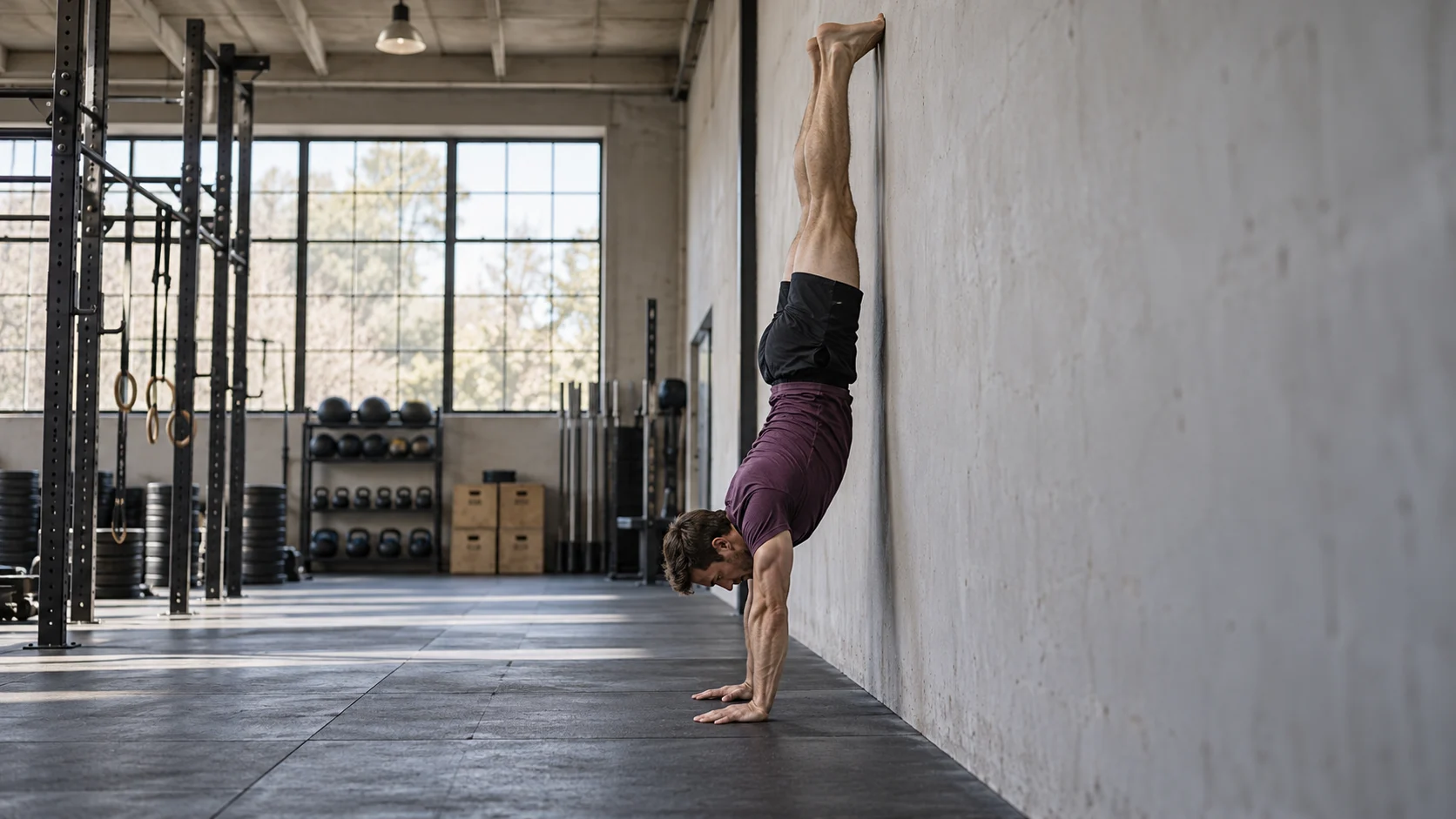
A handstand holds an inverted position, handstand walking moves through successive hand supports, and a handstand push-up adds a press. Learning one does not automatically establish the others.
Prepare support and the environment
Use a clear area and prepare wrist loading, shoulder support and trunk control progressively. Learn an appropriate entry and exit with a coach before attempting unsupported balance. A wall can provide assistance but does not replace learning how to end an attempt.
Build position before duration
Establish active support through the shoulders, controlled trunk positioning and a manageable line over the hands. Short consistent attempts are more useful than simply extending a collapsing position. Wall orientation changes the task and should be chosen deliberately.
Walking and pressing
Walking requires controlled weight transfer to one hand while the other moves. HSPU require an appropriate pressing progression and a defined range. Strict and kipping versions differ; momentum does not replace the supporting strength and control.
In a WOD
Check the prescribed variation, range and repetition standard. Choose a progression you can maintain within the session rather than accumulating failed attempts. Record wall assistance, distance or repetitions and the exact version.
Explore the wider topic
Read the pillar guide · Choose a suitable workout version
Wall walks and the wall-supported handstand
A wall can be faced or kept behind you depending on the task, entry and exit you control. Seek active hand support, stable arms and a body position you can maintain while breathing. Holding your breath or immediately getting as close to the wall as possible is not a universal correction.
A wall walk gradually brings the hands towards the wall as the feet climb. Both ascent and descent need control. The learning range can be adapted; competition standards provide a separate framework.
From holding to free balance and walking
Removing the wall means controlling balance without that extra support. Prepare a familiar entry, weight shifts and exit. Free attempts are not simply longer wall holds.
Walking then requires transferring weight to free one hand, replacing it and continuing. A few controlled transfers and knowing how to stop are distinct tasks from covering a maximal distance. Ask your coach to choose starting drills based on actual control.
Adding the handstand push-up
Straight-arm support alone does not demonstrate the strength for an HSPU. Practise pressing separately through a suitable pike push-up variation or adjusted range, then combine it with inversion when control allows.
Kipping uses body momentum but does not replace controlled lowering and pressing. Do not practise by collapsing onto the head or improvising an unstable stack of supports.
Make progression observable
Choose one session goal: better support, a consistent entry or a short movement sequence. Record the variation and the final attempts. Simply adding time can hide deteriorating positions.
Allow recovery and account for other push-ups, presses and WODs loading the wrists and shoulders. Stop the relevant task if pain persists or you can no longer control the exit, and have the variation reassessed.
Frequently asked questions
Must I walk on my hands before an HSPU? No. Walking adds locomotion; HSPU adds pressing. Neither replaces the other’s requirements.
Do wall walks guarantee free balance? No. Free balance needs its own adjustments and exit skills.
How long should I hold before progressing? There is no universal duration. Support quality, breathing and entry and exit control also matter.
 Wall walks: technique, common mistakes and progressions
 Core control and toes-to-bar: technique and progression
 Pull-ups: technique, variations and progression