
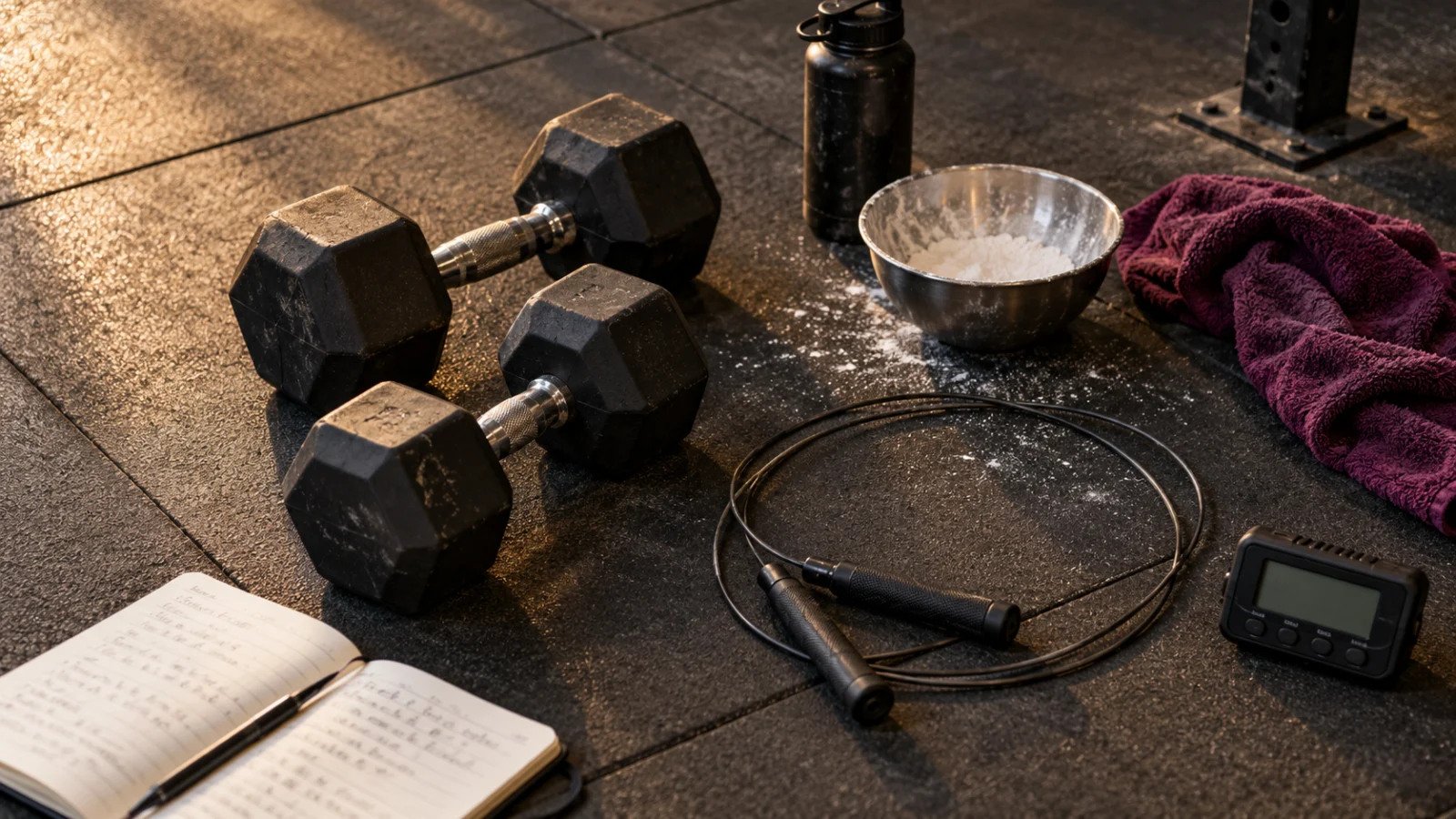
What is a WOD?
WOD stands for Workout of the Day. In CrossFit, it commonly refers to the workout prescribed for a session. Its instructions specify the movements, volume, any loads and how to record the result.
A WOD is not necessarily the entire session. A warm-up, skill practice, strength work and a cool-down may surround it. Read the day’s programme to understand how these parts fit together.
The term also appears in functional training more broadly. A Hyrox-inspired workout may be called a WOD, but that does not automatically make it an official race simulation.
WOD formats: how the work is organised
The format explains the structure: how long you work, when each interval starts or what you need to finish. It does not, by itself, describe the movements, load or difficulty.
AMRAP
An AMRAP asks you to accumulate the prescribed work within a fixed time. The score is often rounds plus repetitions, although some workouts use another total. Check the scoring instructions before starting.
EMOM
In an EMOM, work starts at the beginning of each minute. The time remaining after the prescribed repetitions generally provides recovery. Exercises may alternate, so read the complete sequence and duration.
For Time and chippers
A For Time workout measures how long it takes to finish the prescribed work, sometimes within a time cap. A chipper describes a sequence of tasks to complete. The same workout can therefore be a chipper performed For Time.
Intervals and Tabata
Intervals alternate work and recovery. The Tabata timing commonly used in gyms consists of eight periods of 20 seconds of work and 10 seconds of rest. Timing alone does not define intensity or guarantee a particular training effect.
Benchmarks, Girl and Hero workouts
A benchmark provides a reference: repeat it under comparable conditions to observe progress. Girl WODs are a named family of CrossFit reference workouts, intended for athletes of all genders.
Hero and Tribute workouts honour particular people. Their names do not define a single format or a level everyone must reach. They can also provide training references when you record the exact version performed.
A seasonal theme or editorial selection helps you discover workouts; it is not an additional scoring format. Distinguish the workout’s name, family and actual programme.
The movements: weights, gymnastics and cardio
A WOD may combine several movement families or focus on one. Bodyweight training is not automatically easy, and a barbell workout is not defined solely by its load. Volume and movement proficiency also matter.
| Movement family | Examples | Explore the topic |
|---|---|---|
| Weights and barbell movements | Snatch, clean & jerk, squat, thruster | Weightlifting and related movements |
| Gymnastics | Pull-ups, handstands, muscle-ups, toes-to-bar | Gymnastics and body control |
| Cardio and endurance | Running, rowing, cycling, jump rope | Cardio and endurance |
Learning a movement and repeating it within a workout are different tasks. Establish the technical foundations before trying to retain them under fatigue.
Reading and adapting a workout: RX, scaled and time caps
Check the instructions
Identify exercise order, rounds, repetitions or distances, loads and rest periods. Then check the expected score. A repetition total, a completion time and a maximum load measure different things.
Prescription and scaling
RX means following the workout’s stated prescription. Scaled means one or more elements have been adapted. These are not permanent athlete labels: you may perform one workout as prescribed and scale another according to its movements and purpose.
A time cap sets a limit. If you do not finish, the instructions should explain how to record your result. Changing the load alone may not preserve the intended effort: volume, range of motion, movement complexity and duration may also need adjustment.
Choose a WOD and follow your progress
Start with your available equipment, familiar movements, time for the whole session and other training that week. A workout’s name and duration are not enough to determine whether it suits your aim.
Use Find a WOD to search by name or combine movement, format and workout-family filters. Open the complete workout to read its instructions and choose adaptations before starting. French workout pages are labelled FR; their downloadable workout posters use English.
Record what you actually did: version, loads, movement substitutions, rest and score. These details make a later comparison more useful than the score alone. Every session does not need to become a maximal benchmark test.
WODs in CrossFit and other training
In CrossFit, the workout sits within a broader approach combining different movements and training demands. Understanding that context helps you distinguish skill practice, strength work and conditioning.
Hyrox preparation can also include mixed workouts, but a WOD is not a substitute for understanding the race’s running and station sequence.
Frequently asked questions
Is a short WOD suitable for beginners?
Not necessarily. Duration alone does not describe movement difficulty, load or volume. Consider the entire workout when choosing adaptations.
Can Girl and Hero workouts be scaled?
Yes. A named workout can be adapted in training. For a competition or leaderboard, follow the applicable category rules and record the version performed.
Should I do a WOD every day?
The name describes a workout, not an obligation to train daily. Your schedule depends on your aims, experience and recovery.
 WOD formats: AMRAP, EMOM, For Time and intervals
 WOD benchmarks: Girl, Hero and tracking progress
 RX, scaled and Elite: understand and adapt a WOD