
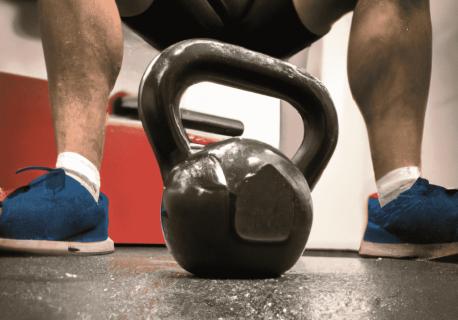
One implement, different tasks
A kettlebell can be used for controlled strength exercises, carries and ballistic movements. That range of options makes it versatile, but it does not mean one load or technique suits every exercise.
Begin with the movement you want to practise and choose a manageable load. A simple session with a clear objective can be more useful than combining every kettlebell exercise into one circuit.
Swing and snatch
The swing uses a coordinated hinge and hip drive. Learn its setup and return before increasing repetitions. Swing height and style depend on the prescribed task.
A kettlebell snatch takes the bell overhead in one continuous action, commonly from a hang or backswing. It is not simply a heavier swing or a mandatory lift from the floor on every repetition. Our kettlebell snatch guide explains the skill and supporting practice.
Clean, press and jerk
A clean brings the bell into a rack position. A press then moves it overhead without the leg drive of a push press. A jerk involves a drive and receiving action, so those terms should not be used interchangeably.
Practise the rack and overhead positions with coaching. The bell should remain controlled rather than striking the forearm during the transition.
Turkish get-up
The get-up moves through a sequence from the floor towards standing and back. Learn the sequence without a load first, then add an appropriate implement if ready.
It is a deliberate positional task, not an exercise that needs to be rushed into a timed circuit. Give yourself enough room and instruction for both directions.
Goblet squat and carries
A goblet squat holds the bell close to the chest while you squat through a range you can control. See the goblet squat guide for the movement context.
A farmer's carry uses a load in each hand while walking. Define the route, load and distance, and keep enough space to put the weights down deliberately. A single-arm carry is a different variation and should be recorded as such.
Russian twists and other accessories
The source includes Russian twists among possible exercises. Agree the range, support position and repetition counting with your coach rather than assuming raised feet and a heavy bell are compulsory.
Exercise selection should follow your objective. You do not need to include every movement listed here in a single session.
Build the session around repeatability
Warm up, rehearse the chosen movements and record the load and repetitions. Use short skill sets with adequate recovery when learning, rather than treating a new technique as a conditioning test.
Our kettlebell buying guide covers equipment details. The scaling guide explains how to adjust a written session to your current ability.
 8 conseils pour s’entraîner pendant l’été sous le soleil