
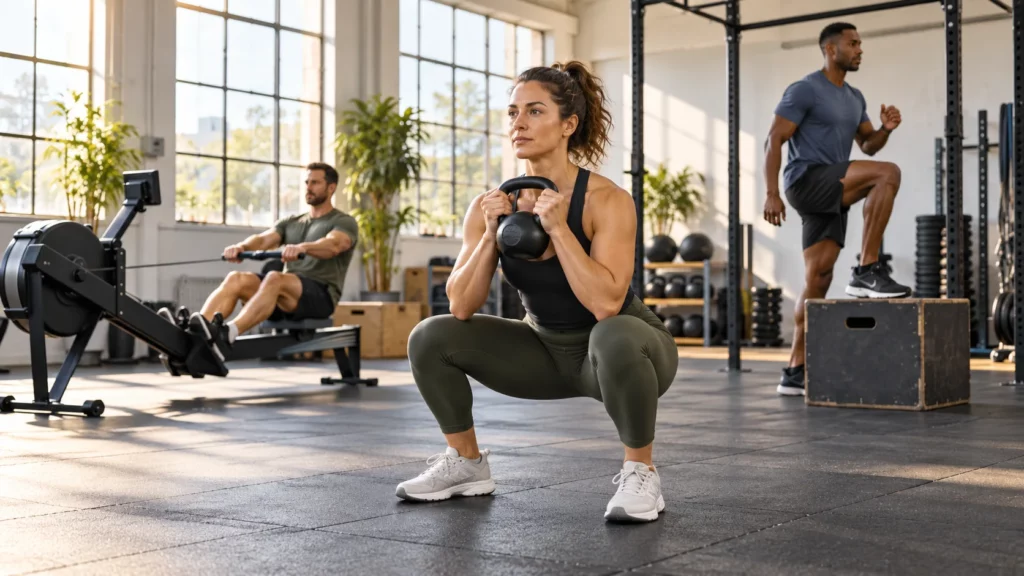
What is cross training?
Cross training combines activities to develop complementary qualities. A week might include strength work, running, rowing and bodyweight exercises. A session can also combine several stations. There is no single compulsory circuit or session length.
Variety should serve a purpose: building general fitness, supporting another sport or making training easier to maintain. It does not mean changing every exercise each session or always working at maximum effort. Repeating selected movements helps you learn and track progress.
Cross training, CrossFit or HYROX?
| Approach | What defines it | Explore |
|---|---|---|
| Cross training | A broad approach combining activities around a training purpose. | Choose the qualities to develop and the resources available. |
| CrossFit | An identified methodology using varied functional movements at relative intensity. | Understand CrossFit |
| HYROX | A competition with a defined running-and-stations format requiring specific preparation. | Discover HYROX |
Classes labelled “cross training” can differ considerably between gyms. Ask about the session content, available adaptations and the coach’s role before choosing.
Build a session around a clear purpose
Start gradually and rehearse the planned movements at an accessible difficulty. Leave time for the main work, an easy finish and recording the session. A timer helps organise training; it does not require you to sacrifice movement quality for speed.
- Strength: choose a squat, hip hinge, push or pull to suit the session.
- Endurance: use running, cycling or rowing at a chosen pace, with planned duration and breaks.
- Coordination: practise a skill while relatively fresh before adding it to a circuit.
A coached class can provide feedback while you learn. Complex movements and unfamiliar loads are not required for a useful first session.
A simple example to find your starting point
Wodball example, to adapt: after warming up, complete three rounds of 6 squats to a stable bench, 6 incline push-ups on a fixed support and 2 minutes of brisk walking or easy cycling. Rest for one minute between rounds, or longer when needed. Aim for consistent execution rather than a time ranking.
Adjust the range of motion, support height and repetitions. Replace unsuitable variations with your coach. Stop an exercise that causes pain. This example illustrates session organisation rather than an individual programme.
Progress without increasing everything at once
Keep selected conditions consistent: movements, repetitions, load, duration and rest. As you become more comfortable with a session, change one element so you can understand its effect. More consistent pacing or better movement control can also indicate progress.
WHO guidance encourages starting with small amounts of activity and increasing gradually. Cross training can help organise different activities, but the label does not guarantee rapid results or injury prevention. Allow recovery time and account for your other activities across the week.
At home, in a gym or outdoors?
At home, begin with a clear space and stable supports; you do not need several machines. In a gym, compare coaching and adaptation options. Outdoors, consider the surface, weather and access to water.
Read our summer training advice, explore cardio and endurance or plan a home gym around your budget.
Choose your next step
Explore WOD formats to understand session instructions. Use the weightlifting and gymnastics guides to learn movements. Start with a purpose and a repeatable difficulty; equipment and speed can follow.
Sources
 Eight practical tips for training in summer heat
 Kettlebell cross-training: movements and session planning