
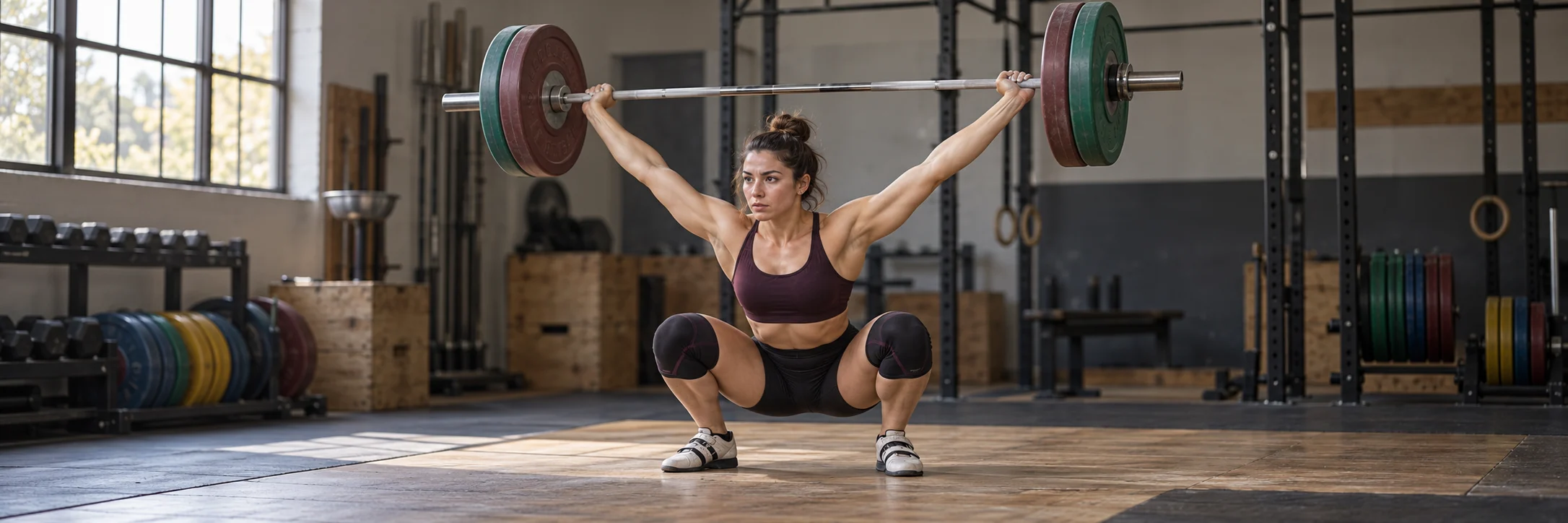
What is a squat snatch?
The squat snatch moves the bar from the floor to an overhead squat reception, then finishes standing with the bar controlled overhead. It combines the pull, movement under and recovery rather than treating them as unrelated exercises.
Its receiving depth distinguishes the stated task from a power snatch. Check the programme or competition standard before comparing repetitions.
Organise the floor start
Take an appropriate wide grip and pulling stance. Establish a controlled trunk position and balance with the bar close before beginning. Setup varies with the athlete, so copying another person’s exact hip height is not a universal solution.
Prepare the space and a way to return or release the bar as taught. Learn that part of the session before a demanding attempt.
Connect the pull and movement under
Lift with a coordinated leg and hip action while keeping the bar close. As the lift transitions, actively move under and turn the bar over instead of waiting passively for it to reach a perfect height.
The complete action is continuous. Breaking it into phases helps observation, but practice should also reconnect those phases into the lift.
Receive and stand
Meet the bar with a stable overhead support in the squat, then recover to standing while retaining control. A controlled overhead squat is useful position practice, though the dynamic reception adds timing.
If the position is not repeatable, review load, receiving range and the practice version with your coach rather than forcing more full attempts.
Choose a drill for the observed difficulty
A tall snatch changes the start to focus on moving under. A muscle snatch changes the finish and turnover task. Hang starts and pauses change other parts of the sequence.
Choose one observation, select a suitable task, then return to the main lift to assess whether the change helps. More drills are not automatically more useful.
Review the full repetition
A forward-moving bar can involve balance, trajectory or timing; it is not a diagnosis of tight shoulders on its own. Observe when the change occurs. Compare a slow position check with the full movement where useful.
See mobility and positions and learning weightlifting technique to organise that work.
In training and WODs
Technical practice, heavier strength work and timed repetitions need distinct loading decisions. Choose an adaptation before the clock starts if the squat reception is inconsistent.
Record the lift variation, load, repetitions and applicable standard. A power snatch followed by a separate squat is a different practice sequence from one continuous squat-snatch reception.
Explore further
Snatch guide · Squat guide · CrossFit movement demonstrations
 Le tall snatch ou arraché debout
 Le muscle snatch ou arraché en puissance