
Mobility is specific to a position
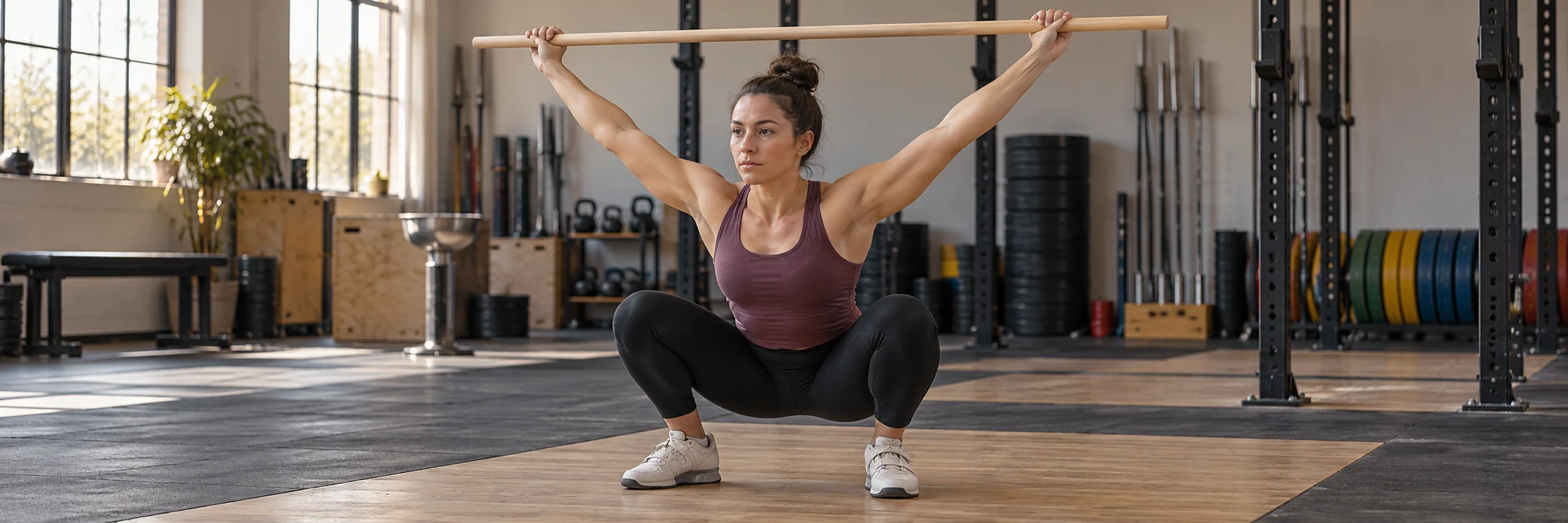
A deep squat, front rack and overhead reception involve different combinations of joint range and control. Mobility is not simply general flexibility, and an unstable lift does not by itself identify a restricted joint.
Observe the squat
Check foot support, stance, ankle and hip movement and trunk organisation. Compare an unloaded position with the loaded task. If balance changes, examine the whole movement rather than applying one stretch to every squat.
Build the front rack
The bar should be supported on the shoulders. Hand contact, elbow position and trunk organisation contribute. Forcing the wrists is not a universal solution; observe the shoulders and how the bar is received.
Prepare overhead support
Snatch and jerk receptions need overhead control with balance over the feet. Grip width, trunk position and the movement leading into reception affect the result. A bar drifting forward can be a timing or path problem as well as a position problem.
Choose useful practice
Use a stick, technique bar or appropriate light load to compare positions. Work on one observed limitation, then retest the relevant movement. Do not force an unfamiliar end range simply to imitate another lifter.
Connect positions to the lifts
Controlled unloaded positions need to be integrated into the moving lift. Track whether a reception is more stable and repeatable, not only whether a stretch feels greater. Explore snatch technique, clean & jerk and technical learning.
Observe the receiving squat
Begin with a slow bodyweight squat in a comfortable stance. Observe foot contact, accessible depth and where balance changes. Foot spacing, foot angle and trunk inclination affect the result; a forward-inclined torso alone does not establish an incorrect squat. Explore a controlled ankle bend in a lunge with the heel down, then repeat the original squat to compare.
Build a front rack supported by the shoulders
In the clean reception the bar is supported on the front of the shoulders; the wrists should not be its only support. The upper back, shoulders, elbows and wrists contribute together. With a suitable technique bar, compare a standing rack and a partial squat. If elbows fall, examine trunk and shoulder organisation before forcing the wrists.
Separate position from transition
Grip width and elbow position can differ between athletes and phases. Moving from clean to jerk may involve adjusting the grip. Learning that transition is a technical task, not something stretching alone can replace. Use a placement that provides stable support for the bar.
Explore overhead control
The snatch and jerk both finish overhead but use different grips and receiving positions. With a light stick and an appropriate wide grip, compare standing support with a partial overhead squat. A difficulty appearing on descent can concern the squat organisation as well as shoulder range. For a jerk, inspect foot placement and reception too.
A short preparation framework
Begin with progressive general movement, then observe one position relevant to the day. Explore a manageable task without forcing it, repeat the original movement with the same stance and grip, and continue into the planned warm-up lifts. This framework is a way to compare positions, not a universal treatment protocol.
Recognise useful change
Choose an observable reference, such as heel contact at a particular depth or a stable partial overhead squat. Record the setup. A position feeling easier immediately after an exercise is useful feedback but not proof of lasting change. Check whether it remains available over sessions and during the lift. If it works slowly but disappears in the reception, examine timing and coordination too.
 Overhead mobility: prepare the positions used in presses and jerks
 Overhead squat: position, balance and progression
 Snatch flexibility: explore the start and receiving positions