
Start with the route, not the headlamp
Plan an after-dark run on a map first and, ideally, inspect it in daylight. Prefer a familiar, lit route with pedestrian space separated from vehicles. A short loop can be easier to adapt than a remote out-and-back: shorten the session if lighting, weather or ground conditions change.
Identify crossings, car-park exits, works and unlit sections. A pleasant summer route can become harder to read with leaves, puddles and branches. If you cannot see the surface early enough to slow down, change route or train indoors.
Seeing and being seen are different jobs
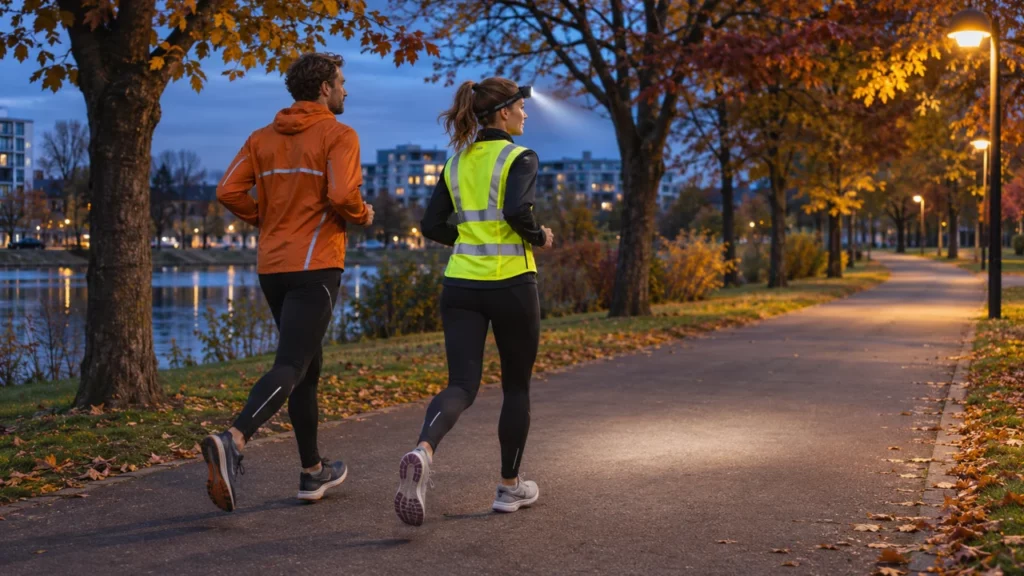
A headlamp illuminates your path; retroreflective details return light that reaches them, including vehicle headlights. Light-coloured clothing also helps but does not replace those functions. French road-safety guidance recommends light clothing and retroreflective strips for pedestrians in poor visibility.
Keep visible details at the front, back and sides rather than hiding them under a bag. Aim the headlamp at the useful ground ahead without dazzling people approaching. Equipment does not guarantee a driver has seen you: slow at conflict points and check before crossing.
Which lighting and equipment should you carry?
| Item | What matters |
|---|---|
| Headlamp | Stable fit, a beam suited to the route and battery life in the mode you actually use. |
| Visibility | Uncovered retroreflective details; appropriate additional lighting when needed. |
| Shoes | Comfort and grip for the planned surface, without assuming any sole prevents every slip. |
| Clothing | Layers suited to weather and effort without restricting movement. |
| Phone | Enough charge and an accessible way to contact someone. |
There is no universal lumen figure for every run. Street lighting, speed, terrain, beam quality and battery life all change the requirement. Test the lamp near home and carry a backup if a failure would leave you without light.
Adjust pace and the session’s objective
Start with an easy outing on a familiar route. Keep faster efforts to sections where lighting, surface and space allow control. Darkness is not a reason to add difficulty: a shorter, steady session may serve your goal better than technical terrain chosen for atmosphere.
For HYROX preparation, a daylight running slot or treadmill session can preserve the training objective when outdoor conditions become unsuitable. Each option needs its own setup; an automatic distance or pace equivalence is unnecessary.
Plan for solo or group running
Share your route and approximate return time with someone you trust. In a group, agree the route, pace and regrouping points; nobody should need to speed up to avoid being left alone. A club may offer organised runs on assessed routes. England Athletics highlights group opportunities to support activity after dark.
Keep your attention on the surroundings. Avoid audio that masks vehicles, bicycles or people nearby. Turning back or changing the session is a reasonable decision if a section feels unsuitable.
A final check before leaving
- Known route, identified crossings and an option to shorten it.
- Weather and surface suitable for the session.
- Charged lamp, tested beam and unobstructed visibility details.
- Accessible phone and a shared return time.
- Pace matched to what you can actually see rather than the planned stopwatch target.
Sources
 CrossFit and running: organise training around your priorities