

Rucking and HYROX are different tasks
Rucking is loaded walking; HYROX combines eight 1 km runs with eight functional stations. Walking with a backpack is therefore not a race simulation. It can have a place in your week if you enjoy it, while the work specific to your goal remains the priority.
There is no official conversion between a rucking distance and a HYROX kilometre. Adding a pack does not turn walking into sled pushing, farmers carries or sandbag lunges: grip, movement and load position differ.
| Goal | Possible role for rucking | Keep in your preparation |
|---|---|---|
| Regular activity | An outdoor outing you enjoy organising. | Running volume appropriate to your plan. |
| Practising load carriage | Steady walking with a secured load. | Station-specific grips and movements. |
| Training variety | A different activity if recovery allows. | Fatigue monitoring and genuinely easy days. |
| A first HYROX race | An optional addition, not an entry requirement. | Technique, running pace and transitions. |
What can it add to a training routine?
A planned walk can support a consistent outdoor habit and provide variety. If you enjoy carrying a pack, you can practise sustained walking without trying to hold a running pace. Its value depends on where it fits in your week.
This is a programming choice, not a guaranteed HYROX performance gain. Load-carriage guidance does not demonstrate that adding a backpack will automatically improve your hybrid race time.
What does it not replace?
Running needs its own preparation: time spent running, pacing and restarting after a station. The stations also have specific movements and division requirements. Retain those tasks rather than replacing them with loaded walking.
A backpack differs from a sandbag across the shoulders during lunges and from kettlebells held in the hands. Rucking reproduces neither sled propulsion nor the SkiErg action. To address a race weakness, begin with the actual task.
Where could it fit in the week?
Look at your existing workload first. If running or lunges have already left your legs fatigued, another loaded session may add more fatigue. An unloaded walk remains a valid choice.
To explore the combination, choose a slot without an immediate key session, easy terrain and a modest load. Check how the walk feels and how well you perform in the following workout. If quality falls, reduce or remove the ruck before increasing volume.
Avoid turning every outing into a challenge
You do not need to run with a pack to prepare the running sections of HYROX. Avoid combining an unfamiliar load, long distance and rough terrain. Military heavy-load targets are not prescriptions for recreational race preparation.
Record total load, duration, terrain and perceived effort. These can explain fatigue that distance alone misses. A short but unfamiliar session may demand more recovery than a familiar walk.
Which priority should guide the decision?
Close to a HYROX race, prioritise familiar, race-specific work. If you are exploring rucking away from a demanding training block, use the beginner guide and build gradually. A useful addition is something you enjoy and recover from, rather than another compulsory session.
Sources
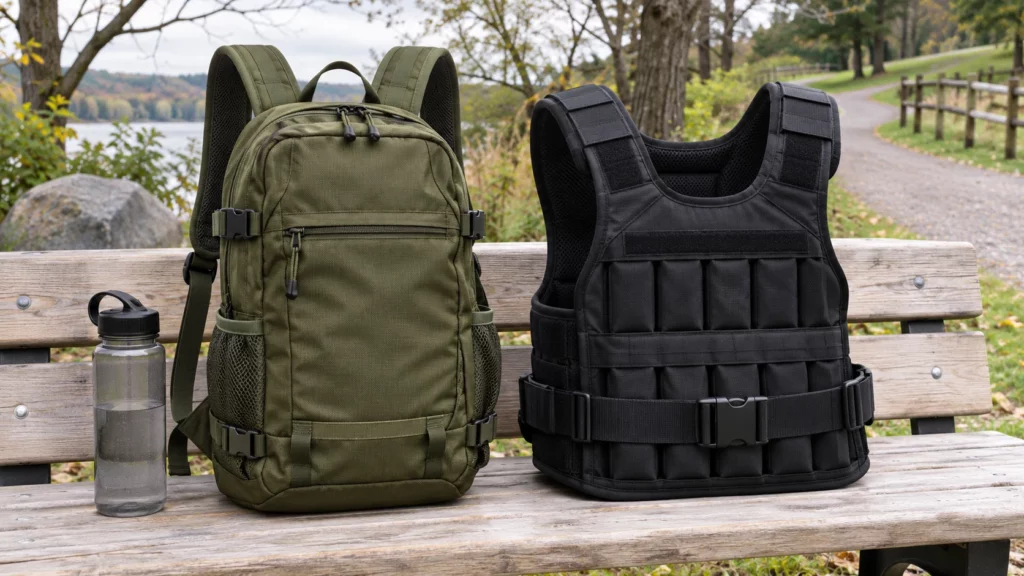 Rucking backpack or weighted vest: which should you choose for walking?
 Running after dark in autumn: visibility, routes and equipment
 New or refurbished rowing machine: what should you check before buying?