

What is a walking lunge?
Walking lunges advance through successive split-stance steps. Lower with control and move into the next step without losing balance. Step length and stance width should suit the task and your proportions.
Build the bodyweight pattern
Begin with controlled unloaded steps. Keep useful foot contact and coordinate the front knee, hips and trunk. Avoid treating a very narrow line or a maximal stride as a universal target.
Load position changes the exercise
Dumbbells at the sides, front-rack loads and overhead support create different demands. Establish the chosen support before walking. A load you can hold standing may not suit repeated lunges.
Read the WOD standard
The programme may count steps, repetitions or distance and specify knee contact, extension and load position. Read those requirements before comparing scores.
Progress and pacing
Choose volume and load that preserve repeatable control. Record step count or distance, implement and variation. Lunges fit lower-body strength and conditioning rather than being solely a gymnastics skill.
Explore the wider topic
Read the pillar guide · Choose a suitable workout version
Start with a repeatable step
Stand with a stable base, then step forward and lower under control before moving into the next alternating step. Choose a step length that lets you balance and stand again without rushing. There is no single ideal stride length for every athlete. Use the movement standard specified by the session when deciding required depth and finish.
Practise before adding external load
Begin with a version you can control, using pauses or a shorter clear route if balance is difficult. Observe foot placement and trunk control through several steps. A coach can help distinguish a placement issue from a difficulty with the task itself.
Compare loaded variations
Dumbbells or kettlebells at the sides, a front-rack load, a sandbag and an overhead load create different demands. Treat each as its own variation. An overhead version requires control of the load position as well as the lunge, so adding it is more than increasing leg work.
Prepare the walking area
Mark the route and turnaround before starting. Leave enough width for stable foot placement and enough height for any overhead implement. Agree whether the task is counted by repetitions, distance or both. One step commonly represents one lunge repetition, but the workout’s rule takes precedence.
Include lunges in training deliberately
A strength session, technical practice and a timed circuit need different loading and volume decisions. Begin with a manageable amount and account for other lower-body work in the week. Record variation, load, distance and repetition convention so later sessions can be compared.
Find examples in WODs
Open 25.1 uses a fixed walking-lunge distance within a rising ladder. DG combines loaded lunges with dumbbell thrusters and toes-to-bar. Read each complete programme rather than assuming all lunge tasks use the same count, load or scoring.
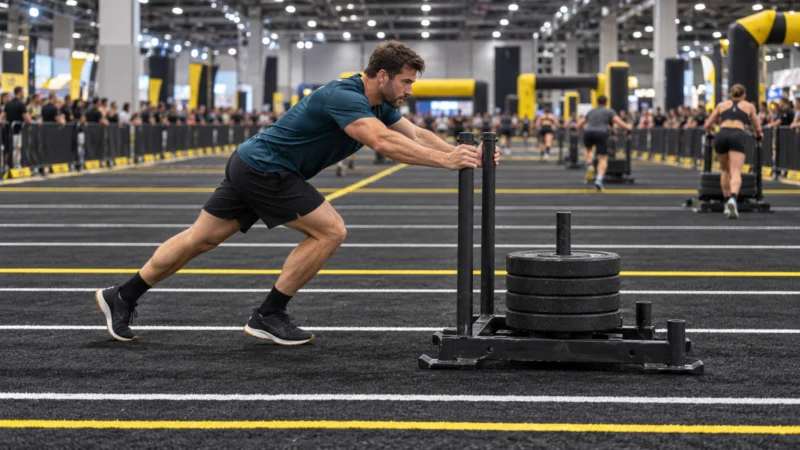 The eight HYROX stations: movements, preparation and running transitions