
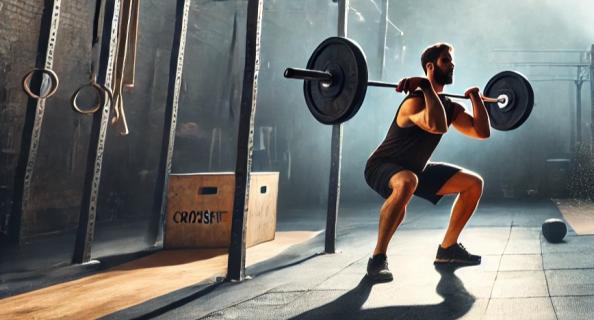
What changes between the two squats?
Both movements involve squatting with a barbell, but its position changes the task. In a front squat, the bar rests on the front of the shoulders. In a back squat, it rests across the upper back in the selected bar position. Grip, trunk organisation and balance must accommodate that placement.
Both use the legs and hips while the trunk maintains a stable position. Neither is universally superior, and a particular bar position does not establish that an exercise is suitable for every beginner.
Set up the front squat
Place the bar in a stable front rack supported by the shoulders, with the hands guiding it. Choose a grip that permits the required position without making the wrists the bar’s only support. Set the rack height so you can unrack without rising onto your toes.
Step back under control, establish a suitable stance and brace before descending. Maintain foot contact and organise the elbows and trunk so the bar remains supported. Stand by extending hips and knees, then return to the rack deliberately.
Set up the back squat
Position the bar on a stable upper-back support appropriate to the variation being taught. It should not simply press into the neck. Take a secure grip, unrack under control and use a short, repeatable walkout.
Descend with a stance and trunk position that keep you balanced over the feet. Some forward trunk inclination is part of many back-squat variations; copying a perfectly upright front-squat shape is not a universal goal. Use suitable rack safeties and learn how to finish and rerack before loading heavily.
Compare the positions you can control
A front squat requires a workable front rack, while a back squat requires an appropriate grip and shoulder position behind the body. Limb proportions, stance and bar placement affect the shape of each lift.
If a position is difficult, examine it with a light load before deciding what limits it. A movement changing during the lift does not, by itself, diagnose a mobility problem. Read the mobility guide for a way to observe positions.
Choose according to the session
Front squatting is relevant to the squat-clean receiving position. Back squatting offers another way to organise loaded squat strength. A programme may include either or both, with loads selected independently.
Do not automatically use the same kilograms for both lifts or infer that one lift’s comfortable load is suitable for the other. Practice, strength work and a timed WOD also need different load and volume decisions.
Begin with a manageable version
A goblet squat or unloaded squat can help explore stance and balance before introducing a barbell. The useful starting point depends on the athlete and coaching setup, rather than one compulsory sequence for everyone.
Record bar position, load, repetitions and depth or standard. Compare like-for-like attempts instead of treating every squat variation as the same test.
Frequently asked questions
Is one always safer for knees or the back? A universal ranking is not a useful way to choose your task. Load, execution, preparation and individual circumstances matter.
Can I train both? Yes, where they fit the programme and recovery. They need not be maximal sessions or use the same load.
Explore further
Squat technique · Clean and jerk · CrossFit: the front squat
 Muscle snatch: turnover, overhead finish and technical practice
 Squat snatch: connect the pull, reception and recovery
 Sissy squat: technique, support and progressions